
Third Friday of Advent

Scripture Reading for Today:
Is This Your Usual Way of Dealing With Humanity?
by Jon Coutts

This felt like the worst year of my life. Maybe in retrospect it will not even crack my top five, and I doubt it will crack 2025’s global top billion, but my therapist says not to gaslight myself by making it a competition. In any case, I don’t feel like writing on the Advent Reader themes of Coming Light or Hopeful Presence right now. At least not if I have to pretend that I think 2026 will be better.
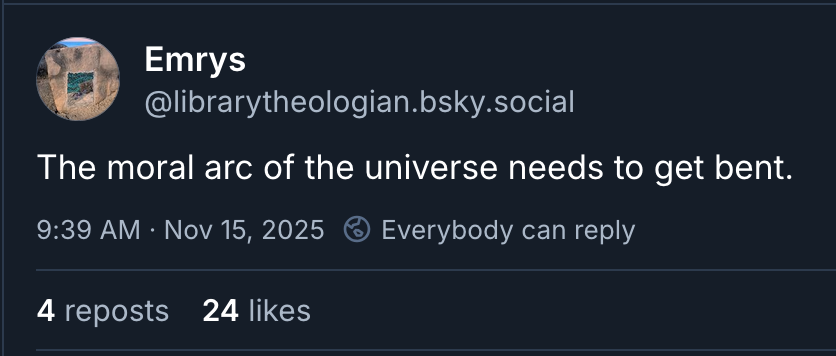
In a certain light, today’s lectionary texts could be helpful. But in another light, they’re kind of depressing. Galatians 4:1-7 ends with the bit about getting to call God “Abba” – which preachers often hold out as a warm hug of acceptance from the God who made us and knows us – and I’m grateful for that. But this is also the passage that talks about the end of slavery and patriarchy, and sadly, that moral arc does not seem to be bending toward justice right now, despite what Martin Luther King Jr. said.* As librarytheologian put it on bluesky recently, “the moral arc of the universe needs to get bent.”
Another lectionary passage is 2 Samuel 7:18-22, which could also go either way. On one hand, it has King David praising God for coming through: “For the sake of your word and according to your will you have done this great thing and made it known… How great you are, O Sovereign Lord!” On the other hand, it also asks: “Is this your usual way of dealing with humanity, O Sovereign Lord?” Anyone who’s read the Psalmist’s other works will know that’s either a genuine question or a bite of sarcasm, and my favourite thing about the Bible is that the divine editor allowed it. In any case, we know that Israel’s not doing great right now, and neither is the world. So, where is this “coming light” that we are talking about?
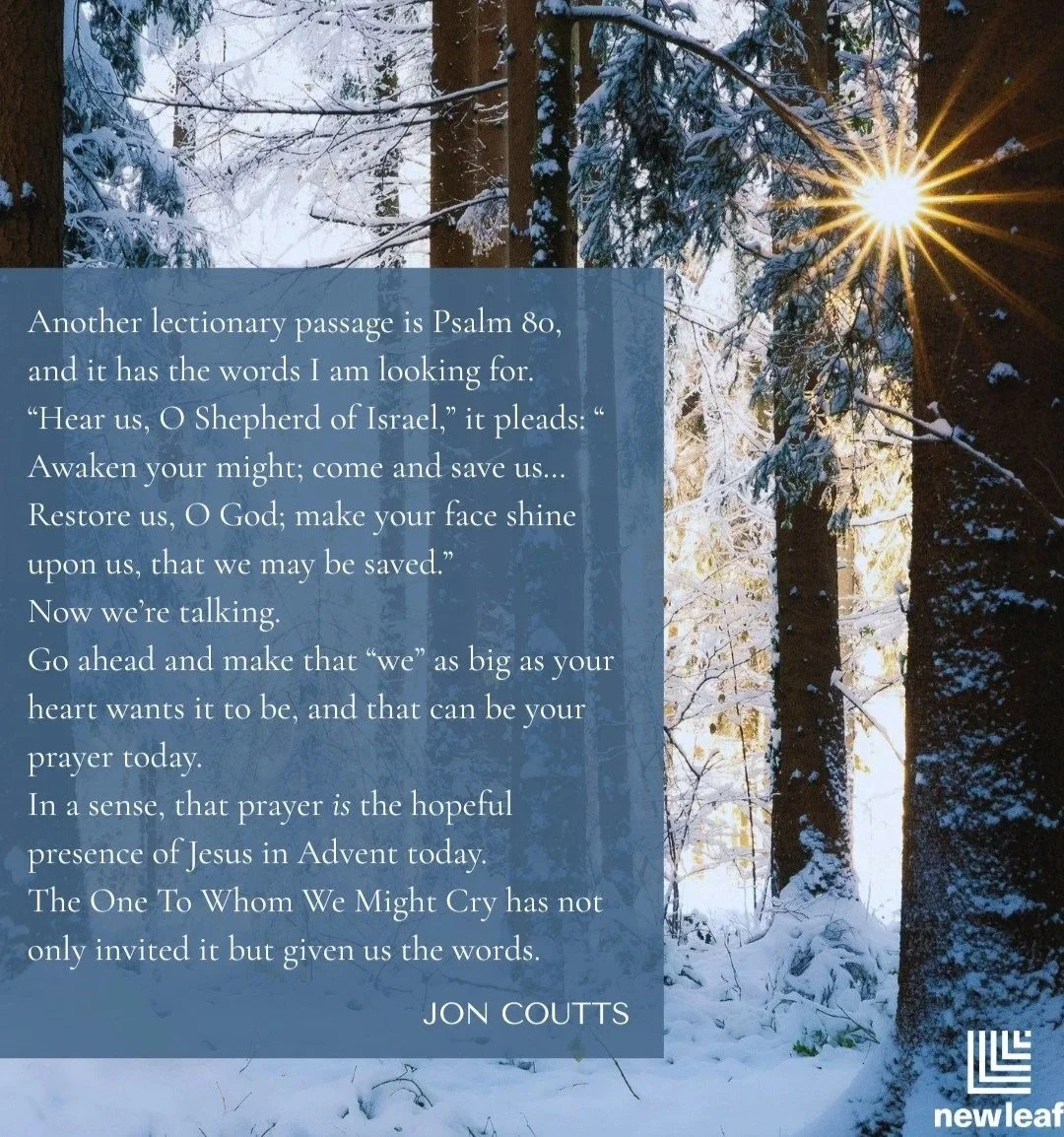
Another lectionary passage is Psalm 80, and it has the words I am looking for. “Hear us, O Shepherd of Israel,” it pleads: “Awaken your might; come and save us… Restore us, O God; make your face shine upon us, that we may be saved.” Now we’re talking. Go ahead and make that “we” as big as your heart wants it to be, and that can be your prayer today. In a sense, that prayer is the hopeful presence of Jesus in Advent today. The One To Whom We Might Cry has not only invited it but given us the words.
Harsh words, even. Psalm 80 goes on: “O Lord God Almighty, how long will your anger smolder against the prayers of your people?” I know the Psalmist wants relief from God’s anger, but as I look at the injustice in the world, the image flips around to a request for more. It reminds me of when I poured water on our fire pit this summer and waited for a few pathetic wisps of smoke to smolder out so I could go to bed. That feels like the state of God’s anger at the bad guys right now.
And I suppose that’s the problem with Psalm 80, too. Even though it gratefully gives us the words to pray, as part of the Bible, it also tells us that the respite we’re praying for is caught up in the fulfilment of Israel by an all-nations Messiah – which in the arc of history still feels like it could be a long time coming.
Where is the hope in all of this?
Back when I taught theology, my most oft-quoted passage of Scripture was Hebrews 11:39-40. There, after reciting a long list of patriarchs and matriarchs, the author ends: “These were all commended for their faith, yet none of them received what had been promised. God had planned something better for us so that only together with us would they be made perfect.”
In class, I would ask what the Bible says perfection is, and the answer would be that it’s not the short-term, local victories, but the long-term global togetherness. If they had experienced its fullness in their time, then it would never have gotten to us. And who knows how long the arc of history has left to bend?
Love wins, says faith. It’s easier said than lived, but it’s the best hope we’ve got.
After a tough year, I have no idea what to do next, but I hope Advent will shed some light. And warmth. As hard as this year has been, it feels like the hopeful presence of Jesus has been in the solidarity of those who reached out. So perhaps I’ll just remind us to keep reaching out to each other. I’m a big fan of English football, and if my team’s fanbase has taught me anything, it’s that you have to keep singing “you’ll never walk alone,” and after a loss, you say “we go again.”
* “The arc of the moral universe is long, but it bends toward justice.” attributed to Martin Luther King Jr. and also Theodore Parker. https://www.npr.org/2010/09/02/129609461/theodore-parker-and-the-moral-universe
Thank you for reading the New Leaf Advent Reader, a collection of reflections from writers across Canada. If you are enjoying the reader, sign up to receive the readings in your inbox here: SIGN UP
And please share this reflection with your friends and family who might also enjoy it.
Explore other Advent Reader reflections:
Explore past Advent Reader reflections: