
Third Wednesday of Advent

Scripture Reading for Today:
Mending What’s Off-Kilter
by Jodi Spargur

I love the unexpected twists in today’s Gospel reading. These departures in the narrative from what we might expect keep us rooted in Advent’s true discipline—watching and waiting in the real, messy details of our lives and the world around us.
Instead of lingering in the usual fare of prophetic foreshadowing and the anticipation of the birth narrative replete with angel encounters, Matthew 8 catapults us straight into the action—giving us a glimpse of what the arrival of Jesus’s kin-dom truly looks like. The chapter is a wild sweep of miracles: healings, the calming of storms, and exorcisms. In this one chapter, Jesus seemingly reaches into every corner of human experience that has been knocked off balance by sin, sorrow, and pain and sets it right. It feels like a moment to shout: Sound the trumpets! Hoist the flag! Declare the victory!
But Matthew, in a gentler and more destabilizing move, slips in a quiet reminder that silences the triumphalism:
“He took up our infirmities and carried our diseases.”
—Matthew 8:17b
Now, Matthew had a lot of material he could have chosen from the prophet Isaiah to emphasize the significance of Jesus’s work as fulfilling ancient prophecies, but he reaches into the portrait of the Suffering Servant—a vision of radical solidarity rather than conquering might. A prophetic tradition that no one at the time would have ever associated with the promised Messiah. Jesus’s authority does not manifest as dominance but as drawing near. He does not crush adversity to rise above it; he comes down into the struggle, lifting what is broken into his own arms.
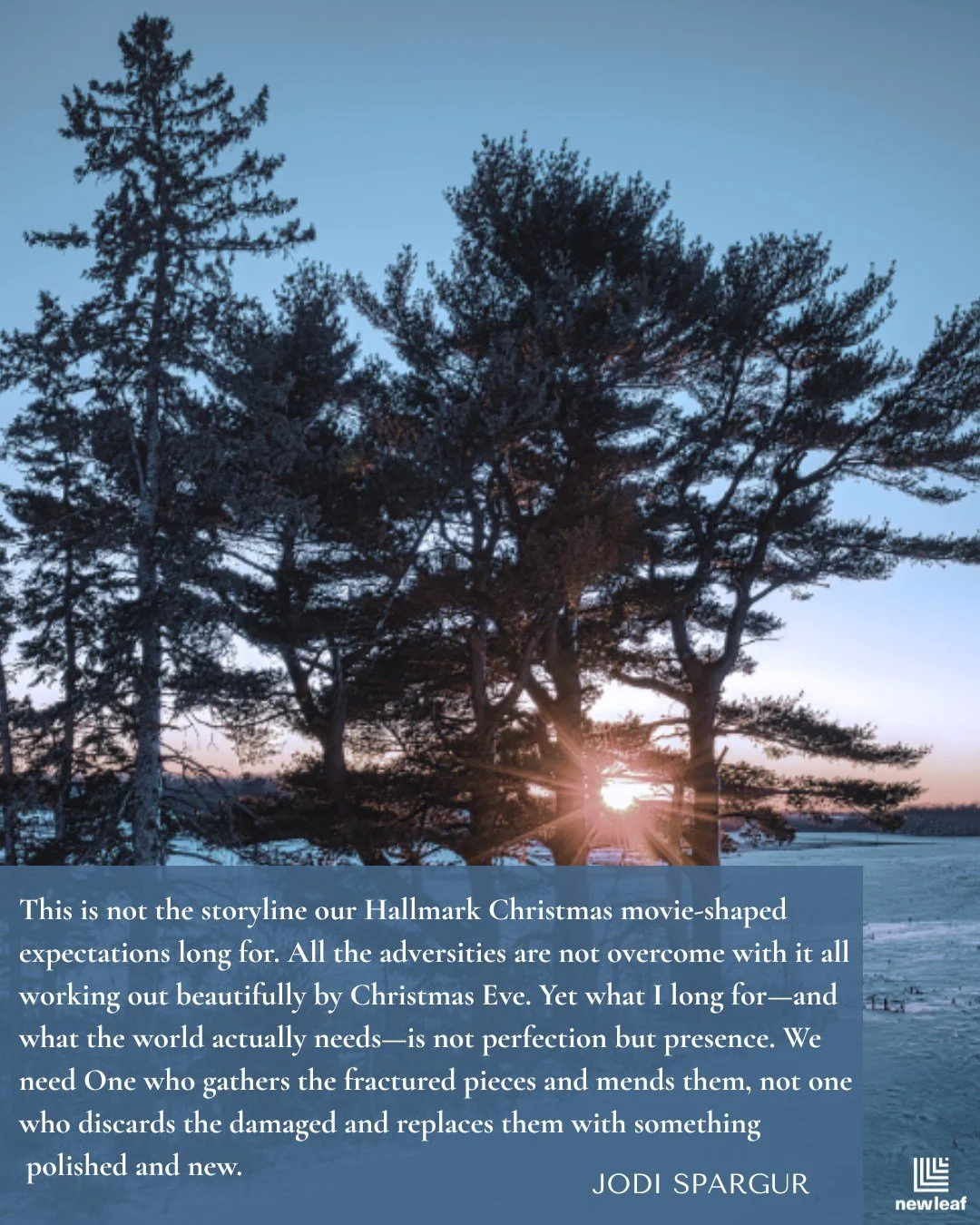
This is not the storyline our Hallmark Christmas movie-shaped expectations long for. All the adversities are not overcome with it all working out beautifully by Christmas Eve. Yet what I long for—and what the world actually needs—is not perfection but presence. We need One who gathers the fractured pieces and mends them, not one who discards the damaged and replaces them with something polished and new. Matthew points us to a Messiah whose power is revealed not merely in the result of healing but in the willingness to bear what harms us: He took up our infirmities.
I have been thinking a lot this Advent about something Kate Bowler said on the first day of Advent this year. Kate is a Canadian, even though she lives and works in the U.S as a professor of church history at Duke Divinity. She also has a podcast, and on the first day of Advent, Kate explored the differences between optimism and hope. “Advent,” she said, “is not about optimism, but about hope.” She went on to describe the differences between the two, but in summary, she maintains that Optimism says, “It will all work out.” But Hope, in contrast, says, “Things are hard, yet God is here—and love actually abounds.”
Things are hard, yet God is here. He took up our infirmities and carried our diseases.
As we carry on in the narrative, we encounter another thwarted expectation. Near the end of the chapter, Jesus encounters two men possessed by demons—men so violent that no one dared travel their road. He casts these demons from the men into a nearby herd of pigs, who then run off a cliff and into the sea. The men are restored to their right minds. The road is now safe to travel once again, and here come the townspeople, looking for Jesus. At this moment, we might expect gratitude from the villagers. Curiosity about this man who has delivered them from these dangerous men. Instead, when the villagers arrive and see Jesus, Scripture tells us:
“They pleaded with him to leave their region.”
The miracle has come at a cost. The herd of pigs—likely a significant economic asset—is gone. The social order has shifted. A status quo—however dysfunctional—has been disturbed. We can only imagine the questions that rose in them: What else might Jesus disrupt? What will His healing demand from us?
The people’s response is not gratitude. It is fear.
Advent hope does not ignore the weight of the world’s pain or the cost of healing and justice. Hope tells the truth. It acknowledges that healing and liberation require change—sometimes unsettling, always transformative. And the only thing that can cast out fear, is love. “Things are hard, yet God is here—and love actually abounds.”
Advent invites us into that costly, courageous kind of hope. We light candles not because the night is gone, but because the darkness is real and God still dares to step into it with us. We wait—not for a God who avoids pain—but for the One who carries it. The kin-dom comes quietly, vulnerably, persistently, mending what is broken even when the healing disrupts our comforts. As we watch and wait this season, may we welcome the God who draws near in our dis-ease, holds what we cannot carry, and transforms us—one unexpected twist at a time.
Closing Prayer
God-with-us,
You come close not with glamour or glitter,
but with hands ready to bear the weight of our wounds.
When Your healing unsettles the systems we cling to,
give us courage not to send You away.
Teach us the discipline of hope—
honest about the darkness,
yet steadfast in trust that You are here,
quietly restoring, gently mending,
loving us back to wholeness.
As we wait for Your arrival,
may we watch for Your presence in unlikely places,
and welcome the unexpected grace You bring.
Amen.
Thank you for reading the New Leaf Advent Reader, a collection of reflections from writers across Canada. If you are enjoying the reader, sign up to receive the readings in your inbox here: SIGN UP
And please share this reflection with your friends and family who might also enjoy it.
Explore other Advent Reader reflections:
Explore past Advent Reader reflections: